Science of Building Movement Habits
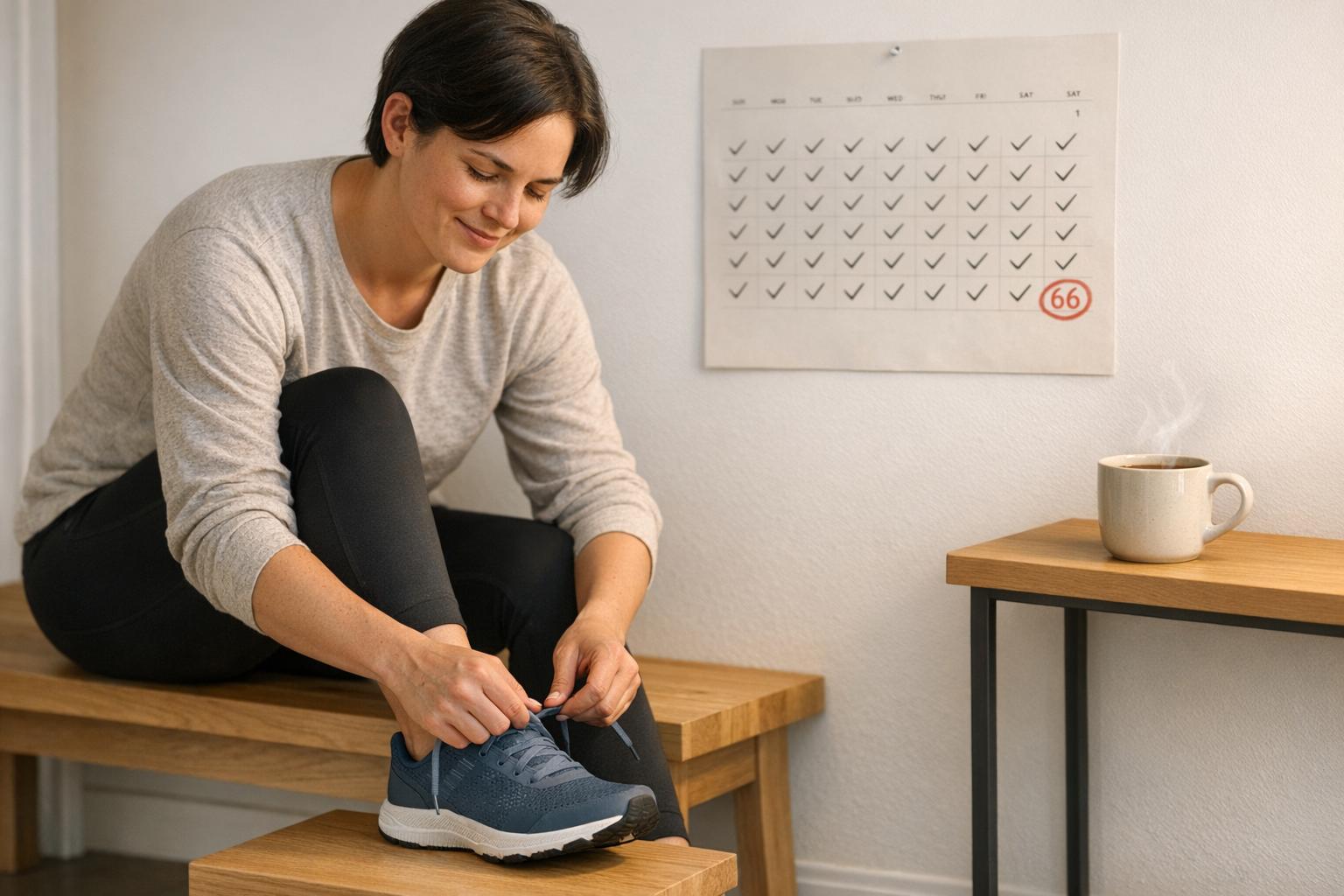
Building lasting movement habits isn’t about willpower - it’s about consistency and working with how your brain forms habits. Research shows it takes around 66 days for a new habit to become automatic, though this can vary based on complexity. Small, repeated actions tied to specific cues help movement routines stick, shifting control from conscious effort to automatic behaviour in the brain.
Key takeaways:
- Habit timeline: Simple habits take 18–30 days; complex ones, like gym routines, need 100–335 days.
- Brain process: Starts with effort (prefrontal cortex) and becomes automatic (dorsolateral striatum).
- Consistency matters: Missing one day doesn’t derail progress, but regular repetition strengthens habits.
- Rewards and environment: Pair movement with enjoyable rewards and simplify access to exercise.
The Science of Making & Breaking Habits | Huberman Lab Essentials
sbb-itb-4048306
How Long Does It Take to Form a Movement Habit?
The idea that it takes just 21 days to form a habit is a common misconception. This belief traces back to a 1960 book by plastic surgeon Maxwell Maltz, who noted that his patients typically needed at least 21 days to adjust to changes in their appearance. However, his observation was about adapting to physical changes - not about creating new behavioural patterns.
Timeline for Building Movement Routines
So, how long does it really take to make a movement routine second nature? Research provides a clearer answer. In a 2010 study, Phillippa Lally and her team found that it takes, on average, about 66 days for a new behaviour to become automatic. That said, the timeline can vary widely - from as little as 18 days to as long as 254 days - depending on how simple or complex the habit is. A 2025 review of 20 studies involving over 2,600 participants confirmed that most habits take between 59 and 66 days to stick, though certain behaviours may require up to 335 days to solidify.
For example, a 2023 study by researchers at the California Institute of Technology analysed data from 30,000 gymgoers over four years. They discovered that while habits like handwashing could form in just a few weeks, it took an average of six months to establish a consistent gym routine.
| Habit Complexity | Examples | Days to Automaticity |
|---|---|---|
| Simple | Drinking water, taking vitamins, flossing | 18–30 days |
| Moderate | 15-minute walk, meditation, journaling | 40–80 days |
| Complex | Full gym workout, 45-minute run, meal prep | 100–335 days |
Habit Formation in Different Groups
Timelines for forming habits can also differ based on individual circumstances and lifestyles. For instance, research by Navin Kaushal and Ryan E. Rhodes highlights that consistency is key for new gym-goers. Their findings suggest that working out four times a week for six weeks (around 42 days) can significantly speed up the process of forming an exercise habit.
"Exercising for at least four bouts per week for 6 weeks was the minimum requirement to establish an exercise habit."
– Navin Kaushal and Ryan E. Rhodes, Researchers
Interestingly, missing a day or two doesn’t necessarily derail the habit-forming process. The key is to maintain overall consistency, as this strengthens the neural pathways that eventually make the behaviour automatic. These insights provide a practical framework for building sustainable movement habits.
Brain Science Behind Movement Habits
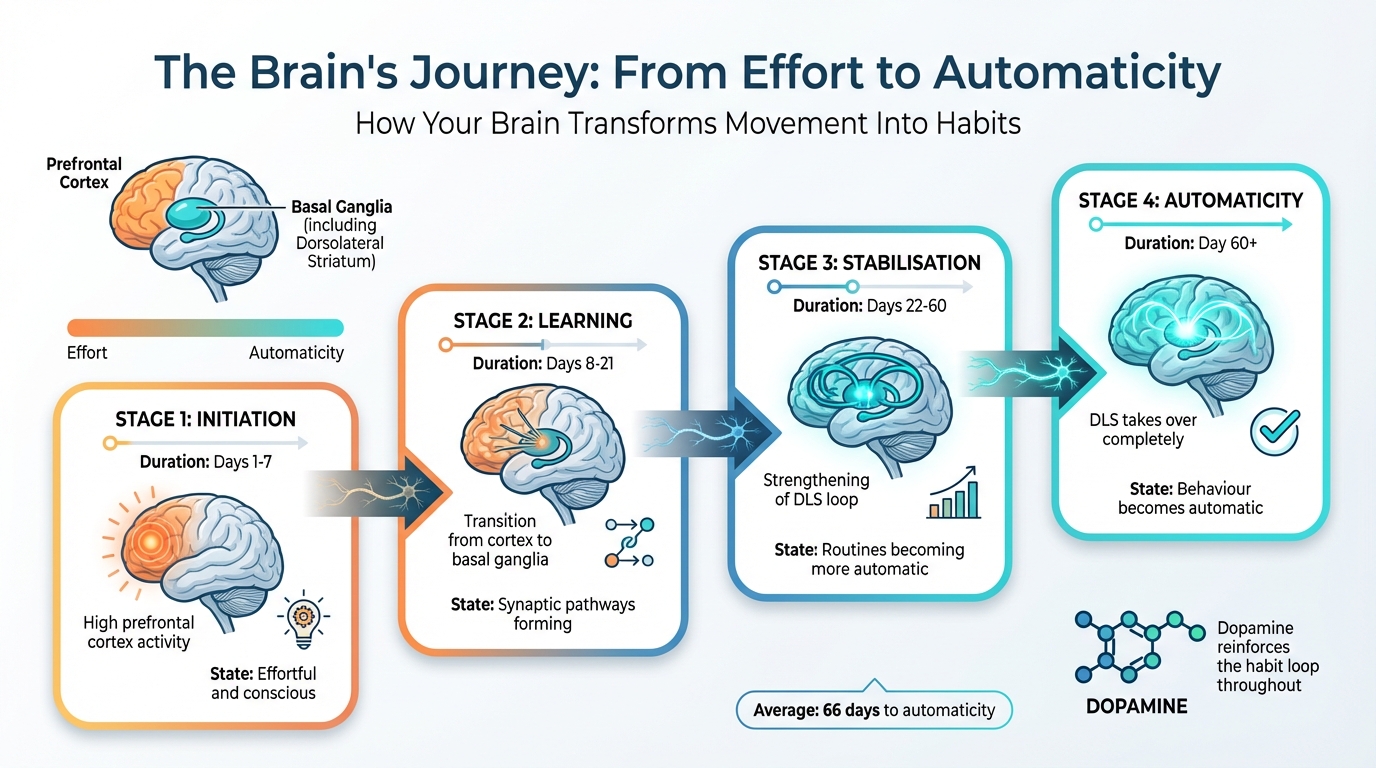
Timeline of Movement Habit Formation: From Conscious Effort to Automaticity
The way our brains work explains why small, consistent actions can gradually turn into lasting movement habits. By delving into the neurological processes, we can see how deliberate efforts evolve into automatic behaviours.
How the Brain Shifts from Conscious to Automatic Movement
In the beginning, the prefrontal cortex is where all the hard work happens. This part of the brain handles decision-making and effort, which is why starting a new workout routine can feel mentally draining. But over time, as you repeat the activity, control shifts to the basal ganglia.
Through repeated actions, the brain strengthens connections between the motor cortex and the striatum, a process called synaptic plasticity. Over time, the brain "chunks" these actions into routines, allowing them to run on autopilot. Once a habit is fully ingrained in the dorsolateral striatum (DLS), it no longer requires conscious effort.
| Phase | Duration | Neurological State |
|---|---|---|
| Initiation | Days 1–7 | High prefrontal cortex activity; effortful and conscious |
| Learning | Days 8–21 | Transition from cortex to basal ganglia; synaptic pathways forming |
| Stabilisation | Days 22–60 | Strengthening of DLS loop; routines becoming more automatic |
| Automaticity | Day 60+ | DLS takes over; behaviour becomes automatic |
These brain changes are further reinforced by dopamine, a key player in habit formation.
Dopamine and Habit Reinforcement
Dopamine plays a crucial role in solidifying movement habits by driving reward anticipation. Often called a "motivation molecule", dopamine isn’t just about experiencing pleasure - it’s about the drive to pursue a reward. When you complete a physical activity and feel good afterward, dopamine strengthens the link between the cue and the behaviour, using what neuroscientists call a "Reward Prediction Error" signal.
"Dopamine is less about the pleasure itself and more about the anticipation of it. It's what drives you to... take that extra step towards a goal."
– Jarrad Van Zuydam, Sports Physician
This creates a feedback loop: cue → routine → reward. Over time, your brain begins to expect the reward. If you skip the activity, dopamine levels dip, creating a craving that pushes you to return to the habit. Physical activity enhances this system by increasing dopamine receptor availability, making your brain more responsive to dopamine and keeping you motivated over the long term. In fact, dopamine spikes in less than half a second after encountering a cue, giving you that immediate urge to act.
What Makes Movement Habits Stick
Building lasting movement routines isn't just about willpower - it's about understanding how the brain works. Consistency and strategic rewards play a key role in creating habits that stick, aligning with the brain’s natural wiring. Two main elements determine whether your movement routine becomes a lifelong habit or fizzles out: regular repetition in stable contexts and the clever use of rewards and environment.
Repetition and Consistency
Repetition is the backbone of habit formation. It’s not about how hard you push yourself but how often you show up. For example, doing 10 push-ups every morning creates a stronger habit than attempting 100 push-ups once a week. Why? Because the brain forms habits by repeatedly pairing a cue with a behaviour, not by the intensity of the action.
Studies suggest that it takes an average of 66 days for a new behaviour to feel automatic, though this can range from 18 to 254 days depending on how complex the habit is. The more consistent you are, the faster your brain adapts. Experts recommend aiming for an 80% adherence rate, which helps develop automaticity without overwhelming yourself.
"Consistency isn't about never missing a single day... it is about showing up more often than you don't."
– Cohorty
Interestingly, missing one day doesn’t derail your progress too much - you retain 90% of your habit’s strength. But missing two days in a row can cut momentum by 58%. This happens because of a brain process called long-term potentiation (LTP), where repeated actions strengthen the connections between neurons. In short, the more often "neurons fire together", the stronger their connection becomes [3,5].
Repetition lays the groundwork, but rewards and environment design ensure those habits stick.
Rewards and Environment Design
While repetition builds the neural framework for habits, rewards and the right environment keep the process engaging and sustainable. The brain’s basal ganglia craves instant gratification - dopamine hits matter more in the moment than long-term benefits like improved fitness or weight loss. To make movement enjoyable, pair it with something you love, like listening to a podcast during a walk or treating yourself to a post-workout smoothie. As BJ Fogg, founder of the Stanford Behaviour Design Lab, puts it:
"Habits are easier to form than most people think if you do it in the right way... it's not a function of repetition, it's a function of emotion."
– BJ Fogg
Your surroundings also play a huge role in shaping habits. Reduce obstacles that make movement harder - like long commutes to a gym or complicated setups for workouts. Small tweaks, such as placing your workout clothes by your bed, keeping a water bottle in plain sight, or choosing activities that require minimal preparation, make it easier to stick to your routine.
Research from 2026 highlights how effective systems and environment design can be. Habit-building workshops, for instance, show an effect size of d = 0.40 for objective activity and d = 0.51 for self-reported movement. On the flip side, relying solely on willpower often leads to failure - 80% of New Year’s resolutions don’t make it past February. By designing your environment to make movement the simplest and most appealing choice, you set yourself up for success. Let your brain do the rest.
Research on Movement Habits and Physical Activity
Building habits around physical activity often leads to more consistent movement patterns than simply relying on motivation. Once people transition from consciously planning their exercise to engaging in it automatically, they’re more likely to stick with it. Research shows that habit-focused strategies have a pooled effect size of 0.31 in improving the automaticity of physical activity, making it easier to maintain regular movement over time.
These strategies work by encouraging repetition in stable environments and incorporating problem-solving techniques, such as identifying obstacles and creating "if-then" plans. Interestingly, delivering these interventions online - through apps or chatbots - has proven to be more effective than offline methods. Online approaches boast an effect size of 0.36 compared to 0.26 for offline strategies, likely due to features like personalised reminders and feedback. This shift toward automatic behaviour not only boosts consistency but also contributes to measurable health outcomes, including weight loss.
Weight Loss Through Habitual Movement
When movement becomes automatic, it removes much of the mental resistance to exercising, making it easier to achieve benefits like weight loss. Habit-based strategies not only enhance activity levels but also lead to noticeable weight changes. A 2023 review found that these strategies resulted in an additional 1.4 kg of weight loss over 8–14 weeks and doubled the chances of achieving a 5% reduction in body weight. Similarly, research from Bond University in 2018 reported an average weight loss of 3.8 kg over 32 weeks when participants focused on habit-building rather than relying solely on willpower. By reducing the need for daily decision-making around exercise, habitual movement makes staying active less of a struggle.
Exercise Consistency and Gym Attendance
For new gym-goers, the real hurdle isn’t starting a routine - it’s maintaining it. A study by Navin Kaushal and Ryan E. Rhodes involving 111 new gym members at the University of Victoria highlighted the importance of consistency and simplicity in forming exercise habits. The research identified consistency (β = 0.21) and low behavioural complexity (β = 0.19) as key factors for building habits. Additionally, habit strength tends to peak after about 12 weeks, after which it either stabilises or begins to decline gradually.
This underscores the importance of creating straightforward, repeatable routines to help new exercisers stay on track.
How to Build Movement Habits That Last
Habit Stacking and Starting Small
Creating a lasting movement routine can be as simple as tying it to something you already do every day. This method, called habit stacking, works by linking a new movement habit to an existing routine. For instance, you could do 15 bodyweight squats right after brewing your morning coffee or perform calf raises while brushing your teeth. In May 2025, fitness researcher Vansh highlighted how seamlessly strength training can fit into your day by using the coffee-making routine as a cue.
The formula is straightforward: "After [Current Habit], I will [New Movement Habit]." Starting small is key - choose actions that take less than two minutes, like holding a 30-second plank after a work call. This keeps things manageable and helps you build consistency over time.
"You do not rise to the level of your goals. You fall to the level of your systems." - James Clear, Author of Atomic Habits
By integrating these small actions into your day, you set the stage for steady progress. Tracking these actions and setting realistic, bite-sized goals can help keep you on course.
Tracking Progress and Setting Achievable Goals
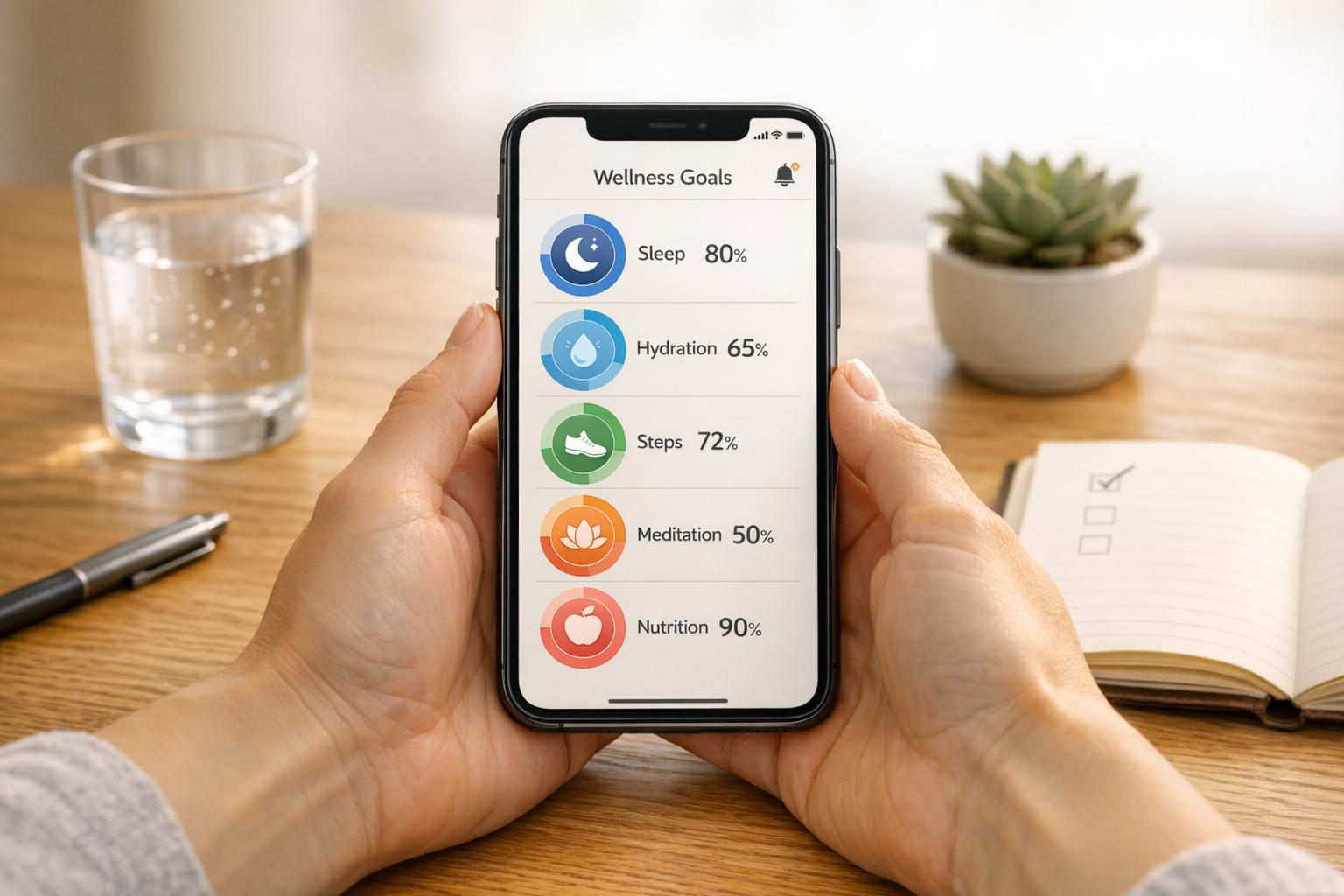
When building a new habit, focus on consistency over perfection. The goal isn't to hit high-intensity targets right away but simply to show up regularly. Using a habit tracker can help you monitor your progress and, more importantly, bounce back quickly if you miss a day.
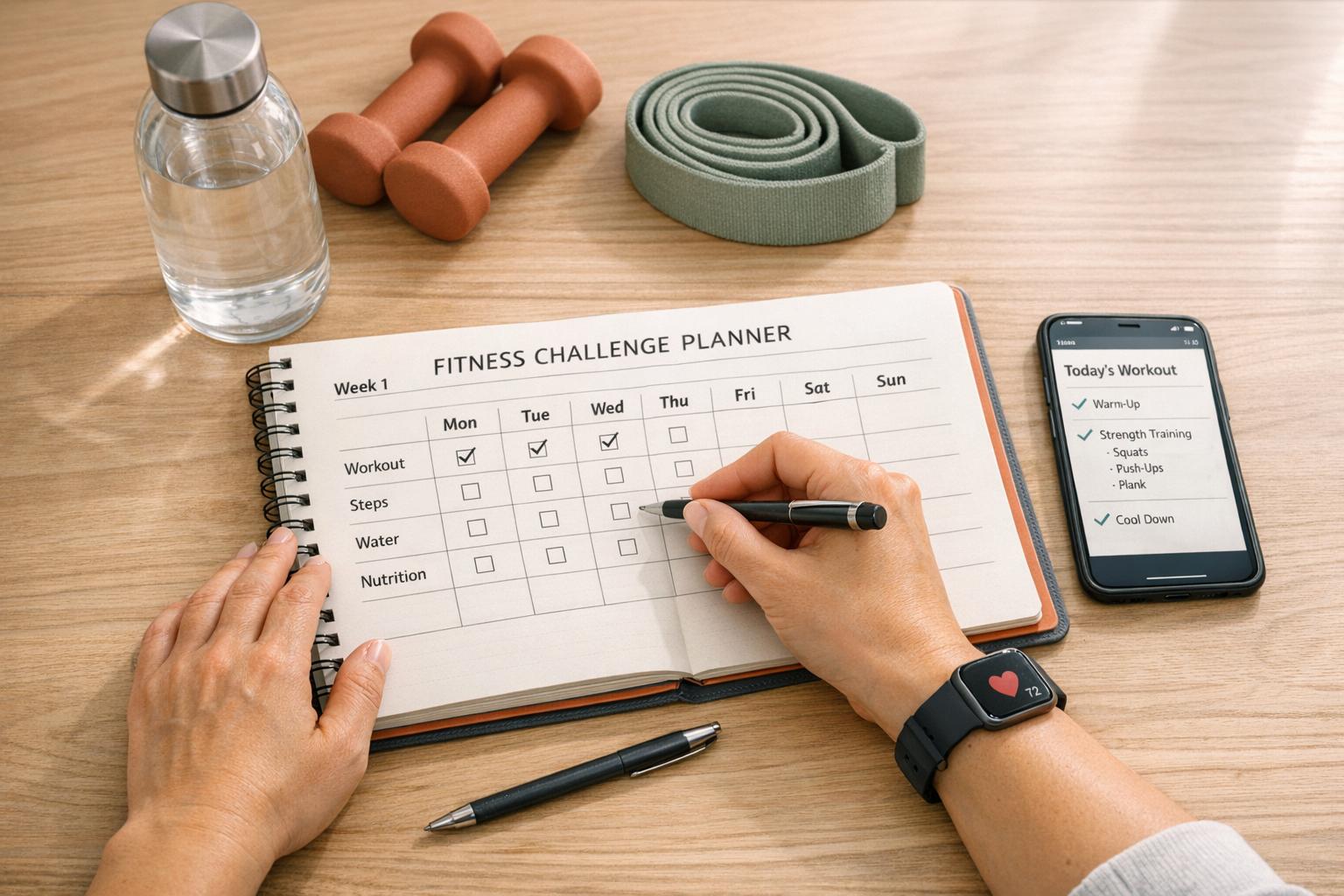
Your environment also plays a huge role in supporting your new habit. Placing items like foam rollers, dumbbells, or resistance bands in frequently used areas of your home can act as visual reminders. Additionally, scheduling movement time in your calendar - treating it as non-negotiable, like a work meeting - makes it easier to stick to your routine.
Using Community Events to Strengthen Habits
While individual tracking is important, being part of a community can make your movement habits even stronger. Social connections provide accountability, especially when your personal motivation wanes. Joining community fitness events creates consistent time and place cues, helping your brain shift the activity from something deliberate to something automatic. Plus, group activities reinforce the idea of being an active person, which makes the habit stick over time.
Events like the Well B Festival offer an excellent way to strengthen these habits. Held at Meydan Racecourse, this three-day festival features activities like bootcamps, fitness challenges, and meditation sessions spread across 16 zones. Engaging with a community that prioritises movement can provide the external accountability you need, especially during those crucial first weeks when motivation can fluctuate.
Conclusion: Building Movement Habits That Work
Developing movement habits takes time - research shows it typically requires about 66 days, with more intricate routines taking as long as 91 days to become second nature. The popular "21-day rule"? It's simply not backed by science.
Here's the deal: habits are built through consistent repetition in consistent settings. The brain's dorsolateral striatum is responsible for storing motor patterns, while dopamine helps cement these actions by rewarding success. Over time, with steady practice, what starts as a conscious effort transforms into automatic behaviour.
This gradual process aligns with what psychologist William James famously noted:
"The more of the details of our daily life we can hand over to the effortless custody of automatism, the more our higher powers of mind will be set free for their own proper work."
– William James
To speed things up, practical techniques like habit stacking, beginning with small two-minute actions, and focusing on immediate emotional rewards can make a real difference. But it's not just about individual commitment - community support is a game-changer for maintaining habits. Events like the Well B Festival at Meydan Racecourse provide the perfect blend of environmental cues, social accountability, and identity reinforcement to help embed movement habits into daily life. This sense of community offers the encouragement and positive feedback needed to keep the momentum going.
FAQs
What’s the fastest way to make daily movement feel automatic?
To make daily movement second nature, rely on consistent cues and routines that engage the brain’s habit-building process. For example, set a trigger like putting on your workout clothes at the same time every day. Start with small, manageable actions that you can stick to regularly. Research suggests it takes around 66 days to solidify a habit, so staying consistent and celebrating small achievements along the way can help strengthen the habit loop of cue, routine, and reward.
How do I restart my routine after missing a few days?
Restarting your routine after a break takes time and a steady approach. Start with small, easy-to-handle steps that naturally fit into your day. Simple cues, like setting a fixed time or putting on your workout gear, can help signal your brain to get back into the habit. Celebrate the little victories along the way to keep your motivation high. Instead of striving for perfection right away, focus on weaving movement into your daily surroundings and letting it grow from there.
Which rewards work best to lock in a movement habit?
Immediate and consistent rewards work wonders when it comes to building a habit of movement. Simple strategies like giving yourself a pat on the back for showing up or celebrating small wins - like completing a week of workouts - can go a long way. These little boosts of positive reinforcement make it easier to stay committed and keep your routine on track over time.