10 Ways Fitness Events Support Green Goals
Fitness events are reshaping how we think about health and the planet. With rising concerns about climate change, these events are focusing on reducing waste, cutting carbon emissions, and promoting eco-conscious habits. Here's how they’re making a difference:
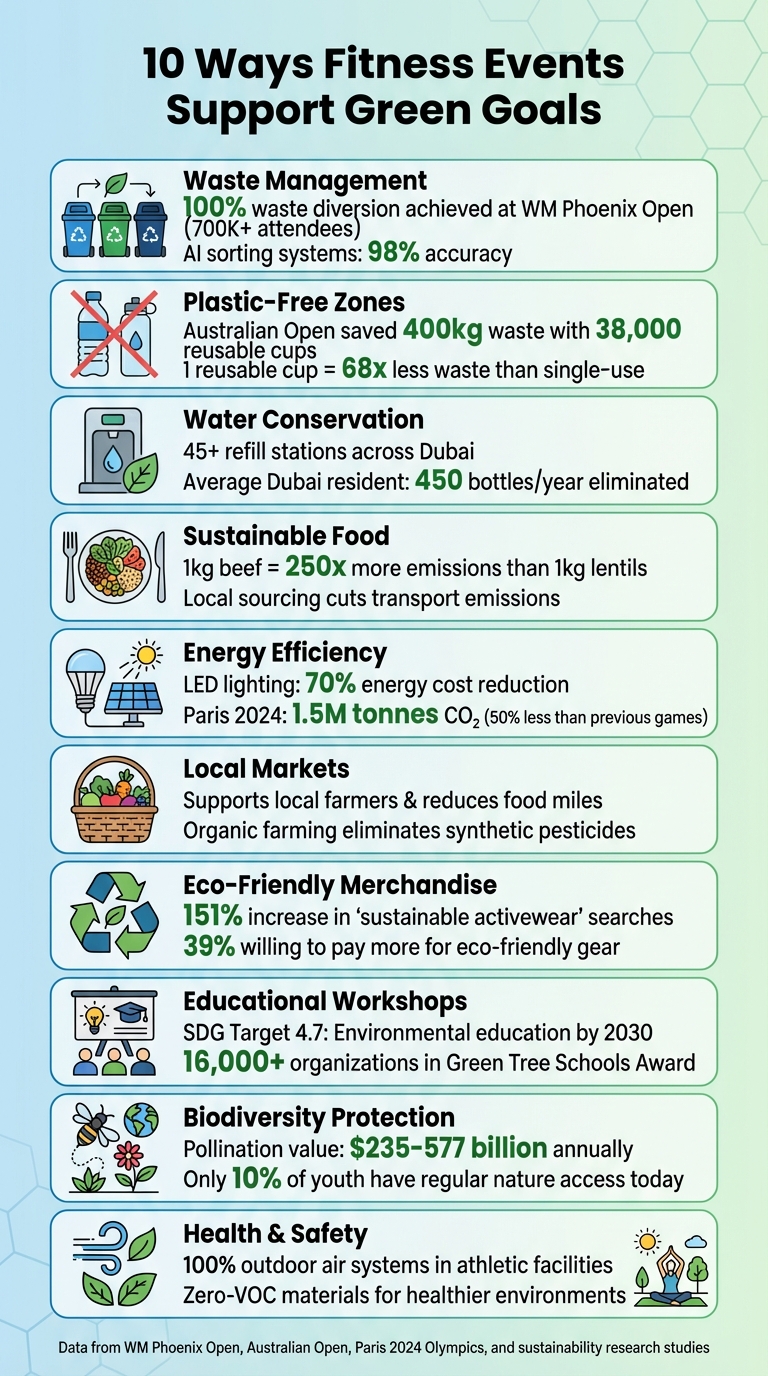
- Waste Management: Using colour-coded bins, compostable materials, and AI-powered sorting systems to reduce landfill waste.
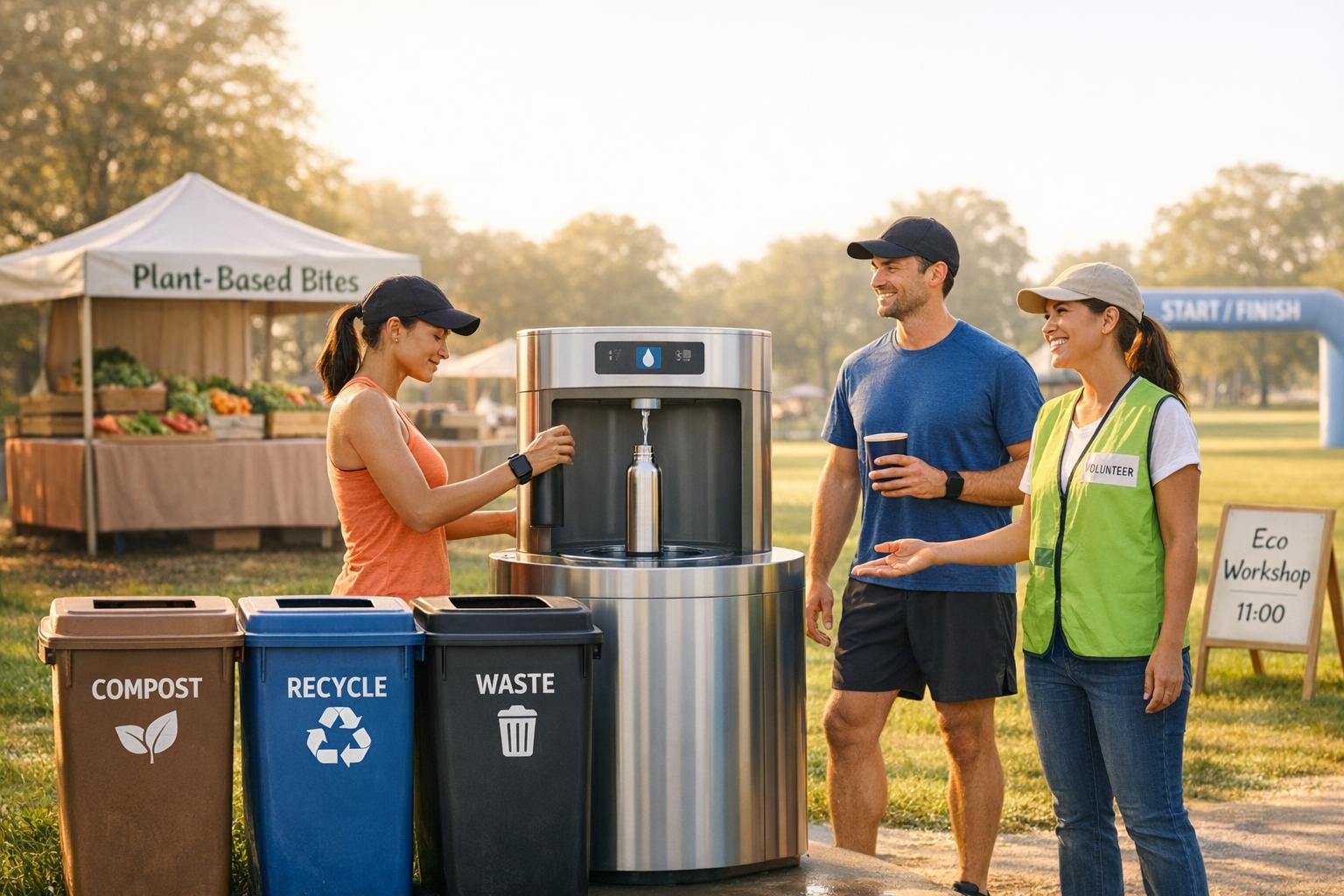
- Plastic-Free Zones: Eliminating single-use plastics with reusable cups, hydration hubs, and compostable packaging.
- Water Conservation: Installing refill stations to replace disposable bottles and encouraging reusable bottle use.
- Sustainable Food Choices: Offering plant-based, locally sourced meals to lower emissions and support local farmers.
- Energy Efficiency: Using LED lighting, renewable energy, and energy-saving equipment to reduce power consumption.
- Local Markets: Highlighting local businesses and organic produce to cut transport emissions and support the community.
- Eco-Friendly Merchandise: Providing items made from recycled or natural materials to reduce waste.
- Educational Workshops: Hosting sessions on sustainable living and conservation to inspire long-term change.
- Biodiversity Protection: Creating pollinator-friendly spaces and protecting native plants to support ecosystems.
- Health and Safety: Prioritising clean air, non-toxic cleaning methods, and wellness-focused zones for participants.
These initiatives show how fitness events are aligning personal health goals with planet-friendly practices, creating a positive impact for attendees and the environment alike.
10 Ways Fitness Events Support Environmental Sustainability
2025 Green Sports Alliance Summit: Mega Event Sustainability
sbb-itb-4048306
1. Waste Segregation and Reduction Systems
Large-scale fitness events can generate a massive amount of waste. To address this, effective waste segregation systems are designed to make proper disposal as simple as possible for attendees. A practical method involves placing colour-coded bins - green for organic waste, blue for recyclables, and red for general waste - every 50–100 metres, especially near food stalls, hydration zones, and entry points. This straightforward setup ensures participants can dispose of waste with minimal effort, paving the way for better waste management practices and future standardisation of materials.
Take the WM Phoenix Open, for example. This event, which drew over 700,000 spectators, achieved an impressive 100% waste diversion rate by integrating reuse, recycling, composting, and recovery systems. Similarly, Ohio Stadium has maintained a waste diversion rate of 90% or higher during its large-scale sporting events, thanks to meticulous waste segregation protocols. These examples highlight how proper waste management is becoming a norm, as venues increasingly recognise its impact on their overall footprint.
"The golden rule? Make the right choice the easy choice." - FSM.How (Facility & Services Management)
Emerging technologies are also reshaping how waste is managed. Innovations like restrictive bin openings, IoT sensors, and AI-powered sorting systems are reducing contamination and improving efficiency. For instance, IoT-enabled smart bins can optimise collection routes, cutting fuel consumption by up to 40%, while AI vision systems can identify and sort waste with up to 98% accuracy. At the Well B Festival, set to take place from 3–5 April 2026 at Meydan Racecourse, organisers are introducing similar waste segregation measures across all 16 zones. This includes fitness demonstrations, food villages, and retail markets, all contributing to reduced landfill waste.
Many events are also requiring vendors to use only compostable or recyclable materials, simplifying the process of managing food waste and packaging. This "upstream" approach, combined with measures like digital ticketing and water refill stations, significantly reduces the amount of waste needing segregation. The Oya Festival in Norway serves as a great example, having switched to 100% compostable food service items and successfully diverting over 60% of its total waste from landfills.
2. Eliminating Single-Use Plastics
Single-use plastics are a significant issue for large events. These gatherings can produce up to 750,000 plastic bottles each. In the United States alone, 60 million plastic bottles are discarded daily, with 80% ending up in landfills where they take an astonishing 450 years to decompose. To tackle this, fitness events are shifting to reusable or compostable alternatives to minimise waste.
One effective solution has been the use of reusable cup systems. For instance, during January 2025, the Australian Open collaborated with Sustainability Victoria and bettercup to distribute 38,000 reusable cups. This initiative prevented approximately 50,000 single-use plastic cups - equivalent to around 400 kg of waste - from reaching landfills. Supporting this effort, Green My Plate provided on-site washing services, creating a circular system. Research shows that a reusable polypropylene cup used 300 times generates 68 times less waste and 60 times less carbon pollution compared to its single-use counterpart.
Some events have gone a step further by banning specific plastic items altogether. In April 2018, the Chicago White Sox eliminated single-use plastic straws through their "Shedd the Straw" campaign, removing over 215,000 straws from their waste stream in just one season. Similarly, the New Forest Marathon adopted strict measures in September 2021, swapping plastic drink bottles for cardboard cups and enforcing rules that disqualified runners who littered outside designated areas.
"Every event organiser has a responsibility to protect the environment they use. Furthermore, we are blessed with a perfect platform to communicate these key messages to those who visit the event."
– Andy Daish, Event Director, New Forest Marathon
Building on these successful examples, the Well B Festival (3–5 April 2026, Meydan Racecourse, Dubai) will introduce "Swarm Spots" - hydration hubs spread across all 16 zones - to encourage the use of personal reusable bottles. Additionally, all vendors in the food villages and retail markets will switch to compostable packaging made from materials like areca leaf or corn starch. This ensures that when single-use items are unavoidable, they can be composted rather than ending up in landfills.
3. Water Refill Stations and Conservation
Water refill stations are transforming hydration at fitness events, cutting down on plastic waste while keeping attendees refreshed. These stations, connected to the grid, provide filtered, chilled water directly on-site, eliminating the need for thousands of disposable plastic bottles at each event. In a place like the UAE, where the average Dubai resident uses around 450 plastic water bottles annually, this shift is especially impactful.
This practical solution aligns with broader environmental efforts. In February 2022, His Highness Sheikh Hamdan bin Mohammed bin Rashid Al Maktoum introduced the Dubai Can initiative, aimed at reducing single-use plastics. By March 2026, the programme has successfully set up over 45 public water refill stations across Dubai, with a particular focus on supporting events like the Dubai Fitness Challenge. This infrastructure not only helps the environment but also ensures public access to clean water in Dubai’s extreme climate.
"This simple switch can eliminate thousands of single-use bottles at each event, making a significant reduction in plastic waste."
– No More Bottles UAE
Event organisers are taking these efforts a step further by optimising the placement of water refill stations. At the Well B Festival (3–5 April 2026, Meydan Racecourse, Dubai), stations will be strategically located in busy areas like entrances, food courts, and activity zones. This ensures easy access for participants engaging in activities such as bootcamps, 5K races, and fitness challenges across all 16 zones.
These initiatives also encourage a long-term shift in behaviour. By combining refill stations with a "Bring Your Own Bottle" campaign and offering reusable bottles for sale on-site (priced affordably between AED 18–37), organisers promote a culture of reuse that extends beyond the event. The mix of convenience, high-quality water, and environmental awareness motivates attendees to ditch single-use bottles - a crucial change in water-scarce regions where every effort to conserve resources makes a difference.
4. Sustainable Food and Beverage Sourcing
Producing one kilogram of beef generates approximately 250 times more greenhouse gases than the same quantity of lentils. This stark contrast has encouraged organisers to prioritise plant-based options such as tofu, quinoa, and chickpeas. These choices not only cut down on carbon emissions but also provide the nutrients needed for recovery.
Choosing local produce is another way to minimise environmental impact. By reducing food miles, transport-related emissions drop significantly. Seasonal, locally grown foods also retain more nutrients and natural flavours, while organic farming methods eliminate the use of synthetic pesticides and fertilisers.
"By opting for local, seasonal, and ethical food sources, you're not just supporting local farmers but also slashing carbon emissions." – Maya Greenfield, Author, McGill Sustainable Events
The Well B Festival, scheduled from 3–5 April 2026 at Meydan Racecourse in Dubai, is putting these principles into action. Across its 16 food village zones, attendees will find menus featuring plant-forward dishes and locally sourced ingredients. This approach aligns with the UAE's increasing emphasis on sustainable agriculture and ensures that participants can enjoy meals that support both their fitness goals and the planet.
Sustainability efforts extend beyond the food itself. Compostable serviceware - made from materials like bamboo or sugarcane - replaces plastics and decomposes within 90 days. Additionally, careful portion planning and partnerships with local charities help tackle food waste, ensuring any surplus finds a meaningful purpose.
5. Energy Efficiency and Carbon Reduction
Switching to LED lighting is a game-changer for cutting energy costs - by as much as 70%. These bulbs consume significantly less electricity than traditional halogen or incandescent options, making them a smart choice for organisers. A great example of this in action is the 2008 Beijing Olympics. Thanks to LED systems and efficient cooling, carbon emissions were kept to 1.18 million tonnes, far below the 3.4 million tonnes recorded during the London 2012 Games. This success with LED technology demonstrates how renewable energy solutions can make a real difference.
Renewable energy sources are also becoming a go-to for major events. Take the Paris 2024 Olympics, for instance. Sustainability Director Georgina Grenon set an ambitious carbon budget of 1.5 million tonnes of CO₂ equivalent - half the emissions of previous summer games. This was achieved by tapping into France's electric grid, which is 95% emissions-free, and using biodiesel and hydrogen generators as a backup. Similarly, the 2022 Commonwealth Games in Birmingham aimed for carbon neutrality by installing solar panels and planting 2,022 acres of forest to offset unavoidable emissions.
"Sustainability, climate justice and environmental protection have always been topics of concern for us as a company... we are also matching our generators to the actual kilowatts requirements rather than expected or estimated requirements." – Gareth Ludkin, Production Manager, Run4Wales
Energy efficiency isn’t just about lighting and power grids - it extends to the equipment used. For instance, in June 2025, Life Fitness introduced the Symbio™ cardio line. This equipment features brushless DC motors and a "Hybrid Mode" that captures energy from users to power the console. Compared to traditional machines, it delivers up to 22% energy savings. At the Well B Festival, set to take place from 3–5 April 2026 at Meydan Racecourse in Dubai, organisers could adopt similar energy-efficient systems across the 16 zones to significantly cut the event's overall energy use.
Smart design also plays a big role. During the 2014 Sochi Winter Olympics, venues were constructed with transparent glass structures to maximise natural light, reducing reliance on artificial lighting. By following the "LEGO" hierarchy - be lean, efficient, green, and offset - fitness events can systematically shrink their carbon footprint. These strategies align seamlessly with the Well B Festival’s goals, showcasing a strong commitment to minimising environmental impact across all event zones.
6. Local and Organic Produce Markets
Choosing locally sourced food is a powerful way to cut down the carbon footprint of fitness events. Transporting food over long distances creates significant pollution, which becomes a major issue for large gatherings. By focusing on local and organic produce, event organisers can reduce emissions from transportation while promoting farming methods that conserve resources and protect air and water quality. Plus, sourcing locally often simplifies packaging needs, which further reduces waste.
The upcoming Well B Festival, set to take place from 3–5 April 2026 at Meydan Racecourse in Dubai, is a perfect example of this approach. Its Rising Hive Market provides a platform for homegrown and emerging local businesses, tying directly into the festival's broader goal of promoting community-driven environmental wellness. Adding to this, the festival’s Buzz Bites food village offers a variety of options from local food trucks and stands, creating a space where thousands of attendees can enjoy fresh, organic meals while supporting regional producers. This setup not only enhances the community vibe but also provides attendees with nutritious, locally sourced food that complements their fitness goals.
"By planning for a 'green' event, organizers can help achieve sustainability by conserving resources, reducing waste, and protecting air and water quality." – Human Kinetics
The Rising Hive Market goes a step further by introducing bulk purchasing and reusable container initiatives, which help minimise waste. For attendees, this means their food choices align with both their health aspirations and environmental values, encouraging a sense of responsibility toward the planet.
Fitness events can also extend these benefits by hosting nutrition seminars that focus on sustainable eating practices. These sessions educate participants on how their food choices - like buying from local farmers - can make a positive impact on the environment. This knowledge equips attendees with the tools to continue making eco-friendly decisions long after the event, inspiring meaningful and lasting changes within the community.
7. Eco-Friendly Merchandise and Materials
Fitness events like Well B Festival are showing how even small giveaways can make a positive impact by offering eco-friendly merchandise. This step aligns with broader efforts in waste reduction and energy conservation, providing a practical way to minimise environmental harm.
Traditional event swag often uses materials like polyester and nylon, which are derived from non-renewable resources. These materials not only contribute to carbon emissions but also release microplastics into waterways, causing further damage to ecosystems. By opting for eco-conscious materials, organisers can reduce their environmental footprint while offering attendees durable, practical items that remain useful long after the event.
Interest in sustainable merchandise is clearly rising. For instance, global searches for "sustainable activewear" have surged by 151% in recent years. Consumer behaviour reflects this trend too - 39% of people globally are willing to pay more for sustainably made sports gear. In the UAE, 22% of consumers are even prepared to spend up to 50% more on eco-friendly fitness equipment.
Today’s events often feature items made from recycled materials such as rPET, which is used for performance hats, cooling towels, and apparel. Natural fibres like organic cotton, bamboo, and hemp are popular choices for tote bags and t-shirts, thanks to their biodegradability and lower resource demands. Other creative options include wheat straw for pens and notebooks, cork for yoga mats and coasters, and stone paper - made without trees - for event journals. For premium items like reusable water bottles and medals, recycled steel and aluminium provide both durability and a smaller environmental impact.
To maximise value, organisers should focus on merchandise that attendees will keep using. Examples include moisture-wicking apparel made from recycled polyester, stainless steel tumblers, and bamboo cutlery sets, which help replace single-use plastics. To ensure these products meet sustainability standards, look for certifications like GRS, OEKO-TEX, or FSC. Additionally, many brands now use compostable packaging, further reducing the overall carbon footprint.
"Sustainable promotional products are items made of eco-friendly materials that are sourced in a sustainable way that limits environmental harm." – Crestline
8. Environmental Education Workshops
Fitness events are increasingly incorporating workshops focused on conservation, sustainable living, and reducing one’s carbon footprint. These sessions aren’t just about learning - they’re about inspiring participants to take actionable steps in their everyday lives. By 2030, global goals under SDG Target 4.7 aim to ensure that everyone gains the knowledge and skills needed to support sustainable development and environmentally conscious lifestyles. At the Well B Festival, this vision takes shape in the Hive Minds zone.
The Hive Minds zone at Well B Festival is a hub for workshops and panels led by experts in sports, health, and wellness. Topics range from movement science and mental resilience to environmental health. As the festival describes it: “Ideas with sting, conversations that matter... from gut health to resilience, mental fitness to movement science”. These sessions tie into the festival’s broader eco-friendly initiatives across its 16 zones, linking personal well-being with environmental responsibility.
Real-world examples of these principles in action are just as compelling. For instance, in March 2026, the California Natural Resources Agency hosted a Spring Cleaning Week-Long Clothing Swap at its Sacramento headquarters. Employees exchanged gently used clothing and accessories, with leftover items donated to local shelters like WEAVE. Similarly, during Biodiversity Week in September 2025, the agency organised an iNaturalist demo led by Deputy Secretary Meghan Hertel and wildlife experts. Attendees learned to contribute valuable data through nature observations, supporting the 30x30 conservation initiative.
These workshops are often spearheaded by specialists from organisations like the Environmental Education Alliance and environmental fellows with expertise in fields such as chemistry, soil science, and agriculture. The outdoor recreation industry, employing around 5 million people in the United States, is also stepping up. As stewards of natural spaces, the industry faces growing pressure to adopt eco-friendly practices and actively support conservation efforts.
Hands-on activities like clothing swaps, biodiversity tracking through apps, and demonstrations of carbon-smart materials resonate deeply with participants. Initiatives like the Green Tree Schools Award have already motivated over 16,000 organisations to embrace outdoor learning and contribute to a healthier planet. By connecting fitness and personal wellness with environmental responsibility, these workshops highlight how individual choices can have a broader impact on the planet.
9. Biodiversity and Native Flora Protection
Fitness events are beginning to recognise that the quality of green spaces is just as important as their size. Research from the University of Essex highlights that exercising in areas with rich biodiversity enhances mental health benefits compared to less diverse environments. This understanding is inspiring organisers to go beyond basic landscaping, taking steps to actively protect and support local ecosystems by focusing on native flora. This shift has sparked creative initiatives that combine fitness with conservation efforts.
Take the Brackenridge Field Lab BioBlitz, for example. Held in April 2025 by the University of Texas, this event showcased how fitness gatherings can also serve as conservation projects. Under the guidance of Field Station Manager Jason Lawson, participants used the iNaturalist app to monitor the recovery of native species after removing invasive plants. With funding from the UT Office of Sustainability's Green Fund, the project tracked the return of local flora and fauna to the urban field station. This interactive approach not only aids conservation but also turns attendees into citizen scientists, fostering a deeper connection to nature.
Similarly, the Well B Festival integrates conservation into its core activities. Hosted at Meydan Racecourse, the festival features a "Bee Well Zone" that blends nature-focused programming with environmental themes. Beyond its branding, the festival's hive concept is a functional initiative to create pollinator-friendly spaces, supporting local biodiversity. By partnering with nurseries specialising in native plants, event organisers ensure the vegetation is suited to the regional climate and contributes to the local ecosystem.
Practical actions for organisers include planting nectar-rich wildflowers and setting up "Pollination Points" to sustain bee populations and preserve native plants. Additionally, participants should be encouraged to stick to designated trails to protect fragile habitats. Alarmingly, only 10% of today’s youth have regular access to nature, a stark contrast to 40% in past generations. By incorporating biodiverse spaces into fitness events, organisers can help reconnect people with the natural world while also supporting critical ecosystem services like pollination, which adds an estimated US$235 billion to US$577 billion annually to global agricultural output.
10. Health and Safety with Eco-Friendly Practices
Maintaining participant wellbeing while adopting eco-conscious practices has become a priority for modern fitness events. These events are proving that high health and safety standards can go hand-in-hand with environmentally friendly choices, moving away from traditional, chemical-heavy methods.
One major focus is air quality, which becomes even more critical during high-intensity activities where breathing rates can increase up to 10 times the normal resting rate. A great example comes from the Syracuse University Athletics Lally Complex, which, in July 2025, introduced an advanced air quality system under the guidance of Andrew Koenings, a sustainability strategist at Gensler. This system uses negatively pressured, 100% outdoor air to ensure a constant flow of fresh air indoors, complemented by natural greenery outside the facility. Additionally, the use of low-carbon and zero-VOC materials helps minimise harmful emissions, creating a healthier environment for athletes.
"In arenas, training centres, and stadiums, air quality is not just a comfort factor - it's a competitive edge, a community responsibility, and a key determinant of health and performance." – Andrew Koenings, Sustainability Strategist, Gensler
Cleaning methods have also shifted towards safer alternatives. Event organisers are increasingly relying on biodegradable, plant-based cleaning products. These not only sanitise effectively but also reduce the respiratory risks often associated with synthetic fragrances and harmful chemicals. This is especially vital in enclosed spaces, where OSHA mandates a minimum ventilation rate of 20 cubic feet per minute per person. Combining non-toxic cleaners with high-efficiency HVAC systems and HEPA filters ensures a safer, chemical-free environment for all participants.
Just like efforts in waste management and eco-friendly merchandise, prioritising a safe and healthy environment underscores a commitment to sustainability. Events like the Well B Festival, held from 3–5 April 2026 at Meydan Racecourse, are leading the way. The festival features 16 specialised zones, including "Bee Healthy" and "RecoverBee" hubs, offering services like health checks, IV therapies, ice baths, and infrared saunas. This blend of rigorous health standards with sustainable practices sets a new benchmark for future events.
Conclusion
Fitness events are showing how health and environmental responsibility can go hand in hand. With practices like waste segregation and eco-conscious operations, these events are making a meaningful difference. The focus isn’t just on cutting down carbon emissions - it’s about creating communities that value both personal wellbeing and the planet's health.
Community involvement plays a key role in achieving these green goals. Initiatives like Sport England's 'Every Move', which committed £45 million to lowering the sports sector's carbon footprint, and the 'Green Gym' programme, boasting a 90% retention rate through conservation activities, highlight how direct participation builds lasting dedication.
"Local people must be involved in order for environmental improvements to be sustainable." – The Conservation Volunteers
The Well B Festival, set for 3–5 April 2026 at Meydan Racecourse in Dubai, embodies this spirit. It features community-focused zones that uplift local businesses, encourage environmental awareness, and promote mindful movement.
These efforts go beyond symbolic gestures - they inspire real, actionable changes. Simple steps like using refill stations or opting for plant-based meals make sustainable choices easier to adopt. As co-founder Jamie Cormack explains, "From the very beginning, Well B was about rethinking what a fitness and wellness event could feel like. We didn't want something static or intimidating. We wanted energy, flow, surprise and community". This vision turns the event into a platform for long-lasting behavioural shifts.
FAQs
How can I help keep the event waste-free?
Supporting a waste-free Well B Festival is easier than you might think. Start by using the recycling bins scattered around the venue to ensure waste is disposed of correctly. Ditch single-use plastics in favour of reusable or biodegradable options, and don’t forget to bring along your own reusable bottles or containers. Keep an eye out for event setups that incorporate sustainable materials, and get involved in any waste reduction activities happening during the festival. Every small action adds up!
Do I need to bring my own reusable water bottle?
Bringing your own reusable water bottle is a great idea for staying hydrated at the Well B Festival. Plus, it’s a simple way to cut down on waste and support the event’s eco-conscious initiatives.
What makes the food options more sustainable?
Food choices become more eco-friendly by incorporating recyclable or compostable utensils and food containers, setting up clearly labelled recycling bins, sourcing ingredients from local suppliers, and reusing equipment and supplies wherever feasible. These steps play a key role in cutting down waste and reducing the environmental footprint of event catering.